
From the Arctic to Chile: Research on Migratory Bird Routes for Their Conservation
A study led by Rocío Jara, researcher at the Center for Local Development (CEDEL UC), and developed alongside the community around wetlands in Maullín in the Los Lagos region, uses small transmitters to monitor the journeys of thousands of kilometers made by the lesser yellowlegs. This information is crucial in designing management and conservation strategies that guarantee the survival of this species, which is categorized as vulnerable.
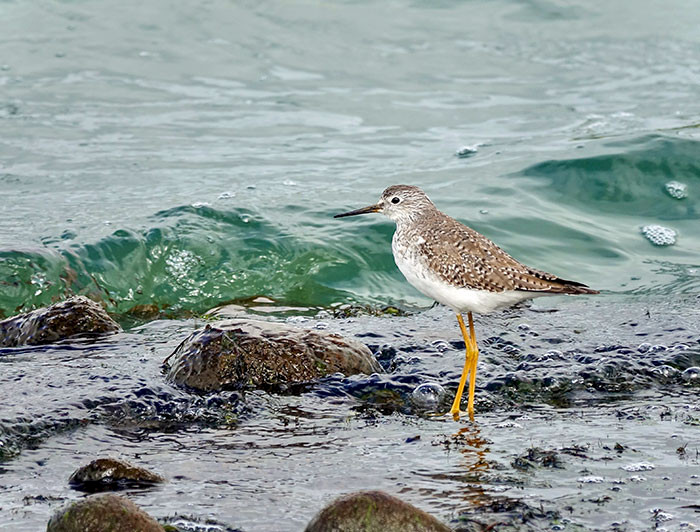
photo_camera This research is possible due to the close collaboration of the community members, who provide their knowledge as well as allow the installation of the monitoring station. (Photo credit: Gabriela Contreras).
The lesser yellowlegs (Tringa flavipes) is a common bird, present throughout Chile from Arica to Magallanes, weighing less than 100 grams, that travels thousands of kilometers every year to the Arctic during its mating season. Then it travels to the south of North America and the whole of South America to spend its non-breeding season.
Currently, the lesser yellowlegs is categorized as vulnerable in the Red List of Threatened Species of the International Union for Conservation of Nature (IUCN). Studies conducted in areas of the United States and Canada have shown a decline in its population.
Among the causes that have been found for its declining population are excessive use of pesticides, indiscriminate hunting in certain countries, and destruction of its habitat for reasons such as the filling of wetlands in urban population projects, among others.
Following the trail of the lesser yellowlegs
“We know nothing about the migration of the lesser yellowlegs that spend the resting or non-breeding season in Chile,” states Rocío Jara, postdoctoral researcher at the Center for Local Development (CEDEL UC, as per its acronym in Spanish).
This is why the idea of research was created with the purpose of understanding the ecology of the birds’ movement, which studies how the movement of the organisms relates to their environment and other species, affecting the dynamics of populations and ecosystems, and the migratory connectivity of the lesser yellowlegs that inhabit the shores of the southern Chile during its non-breeding season.
To achieve this, the project contemplates the installation of a Motus station: devices that can detect and register the movement of birds that carry radio transmitters, in the zone of Lepihué and La Pasafa in the Los Lagos region in the south of Chile. This station connects with a global research network of the same name, created in 2017 by a research team that included Christopher Guglielmo, director of the Centre for Animals on the Move of Western University, Canada, who collaborated with Rocío Jara in the development of this project.

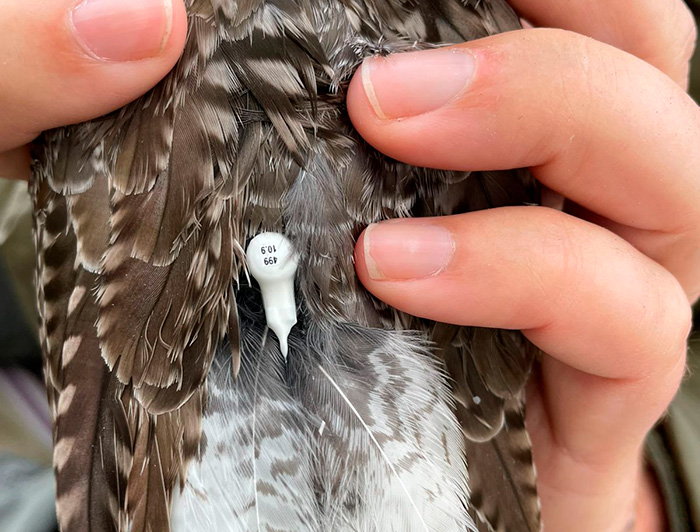
“This is a system of stations to study the movement of animals by means of the detection of transmitters,” explains Rocío Jara. These transmitters are small devices weighing less than a gram that are installed on the back of birds and that emit radio waves, allowing their movement to be recorded by different stations.
“This study allows us to understand key aspects of the migratory movements of this species, such as details of departure and arrival dates, routes, stops, and migratory connectivity, providing useful information to design and implement management and conservation strategies that guarantee the survival of these birds and the health of the wetlands that depend on them,” the researcher explains.
Collaboration with the community
The monitoring station was set up in March of this year in the wetland area in Maullín, Los Lagos region. “These wetlands form part of a network of important sites for shorebirds at a hemispheric level,” explains Rocío Jara, referencing the Western Hemisphere Shorebird Reserve Network.
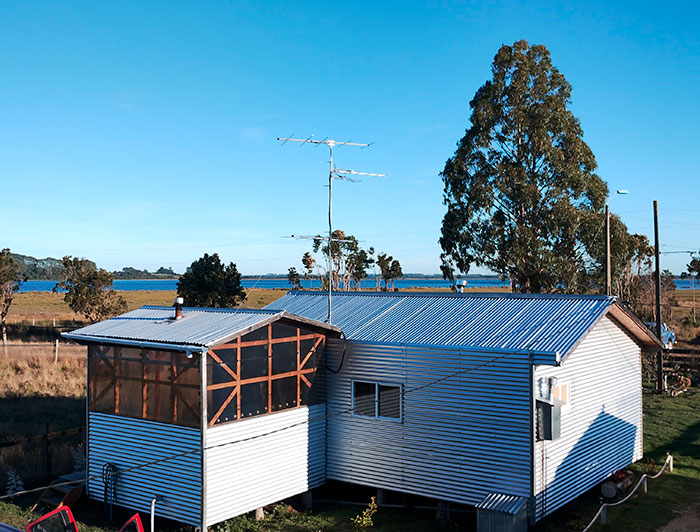
Specifically, the station is located in the Lepihué cabins, with a privileged view of the wetland. “It gives added value to my cabins. Any bird person, aficionado or scientist, will want to arrive and get to know the place,” states Erwin Ruiz, owner of the cabin complex, tour operator and fisherman, who became part of the research.
For Ruiz, who is a fifth-generation fisherman in Lepihué, this research is the result of a decade-long process, starting when the first researchers and birdwatchers arrived in the area. “We had no idea about these birds. For us, all of them were ducks,” he admits. Thanks to being invited to work on projects like this, the tour operator claims to have increased his knowledge of the wildlife with which he lives. “Now I can distinguish the birds, I know about their importance (…) and I now know there is a global network related to the environment, the birds, and their conservation.”
In Mapudungun, the language of the indigenous Mapuche people, Lepihué means “place of feathers”: “lëpi” for feathers of large birds and “hue” for place. As stated by psychologist Bernardita Muñoz, who lives in Los Muermos, 20 kilometers away from this area, “the birdwatching zone is Lepihué and La Pasada, where we always go to.” She also joined the research team as a volunteer, following a call issued through the Chilean Birdwatching Network (ROC, as per its acronym in Spanish).
This area is also the mouth of the rivers Maullín and Quenuir. “This is a place of great importance,” assures Muñoz. “It brings you into contact with nature and this is essential for physical health and especially for mental health.” Alongside Muñoz, a group of 12 volunteers contributed with their expertise and experience to this research, which has been carried out side by side with the community.
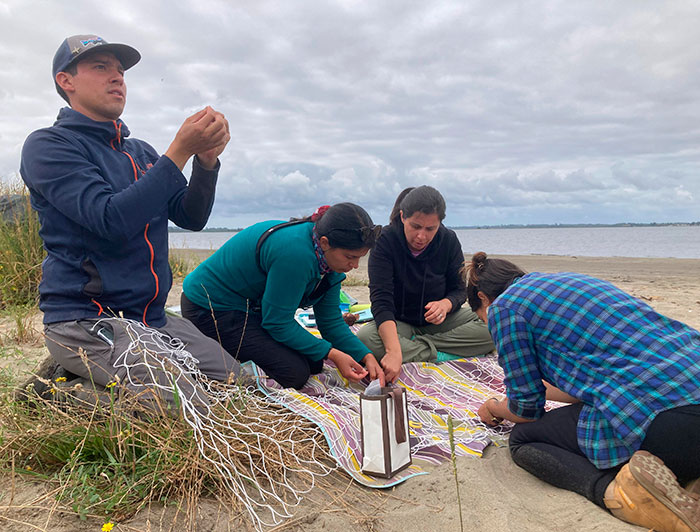
“Working with the community is key,” states Rocío Jara. The researcher explains that in addition to the high interest that neighbors showed at the time the investigation started, the project relies heavily on local knowledge. “The community members are the ones who have key information on the dynamics of birds in this place,” Jara remarked.
A milestone for the Los Lagos region
The preliminary results of the investigation are already available (and can be reviewed in Motus), and the researchers expect to finish collecting data between 2027 and 2028. According to the team, this will provide important background information for the study of bird migration in the Maullín wetlands.
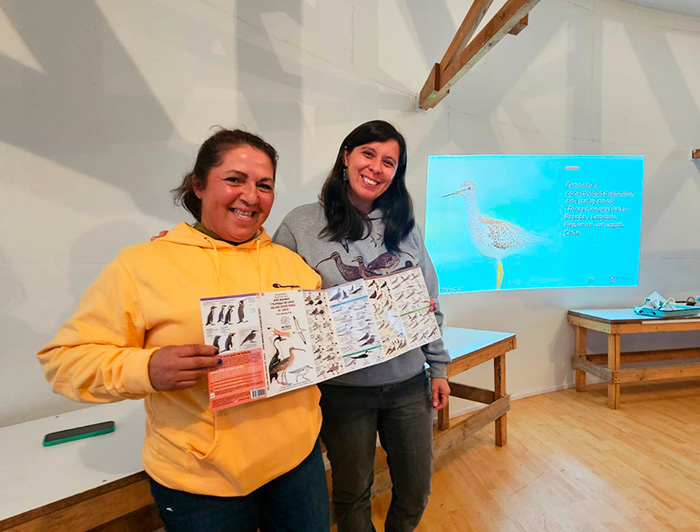
“This is a major milestone for the region, for the Lepihué area, where many migratory birds arrive,” states Bernardita Muñoz. “All of us need to learn much more,” reflects Erwin Ruiz, affirming that, as a fisherman, the responsibility is on him and his colleagues to conserve the wildlife of the zone.
This project is also part of the Action Plan for the Conservation of Chilean Shorebirds, within the National Bird Conservation Strategy (ENCA, as per its Spanish acronym) 2021–2030. This seeks to strengthen bird monitoring at the national level and to advance the consolidation of a Motus network in the country.
The work done for this research was supported by volunteers mainly from the Los Lagos Region, including Edwin Price, Gabriela Contreras, Fernando Medrano, Nicole Arcaya-Orrego, Sarah Saldanha, Danae Garrido, Daniel Terán, Daniel Valencia, Matías Gutiérrez, Eduardo Quintanilla, Bernardita Muñoz, Jorge Alava, Daniela Ruz, Ángeles Díaz, Angélica Almonacid, Felipe Godoy, and Álex Toledo.
Also participating was Ariel Vera, from Turlepihue, and neighbors of the wetlands, who shared their knowledge, curiosity, and enthusiasm, and provided work spaces on their properties.
Motus is a network of automatized radio telemetry stations that are part of a global research community for tracking migratory birds and other species. Each station is equipped with an antenna that detects signals from miniature transmitters placed on the animals, allowing researchers to track their movements from long distances (a 15 to 20 kilometer radius) and obtain data on their migratory patterns and behavior. The network consists of more than two thousand stations in strategic places in 34 countries. To date, this research community has tagged more than 400 species, providing information for almost a thousand projects.


